
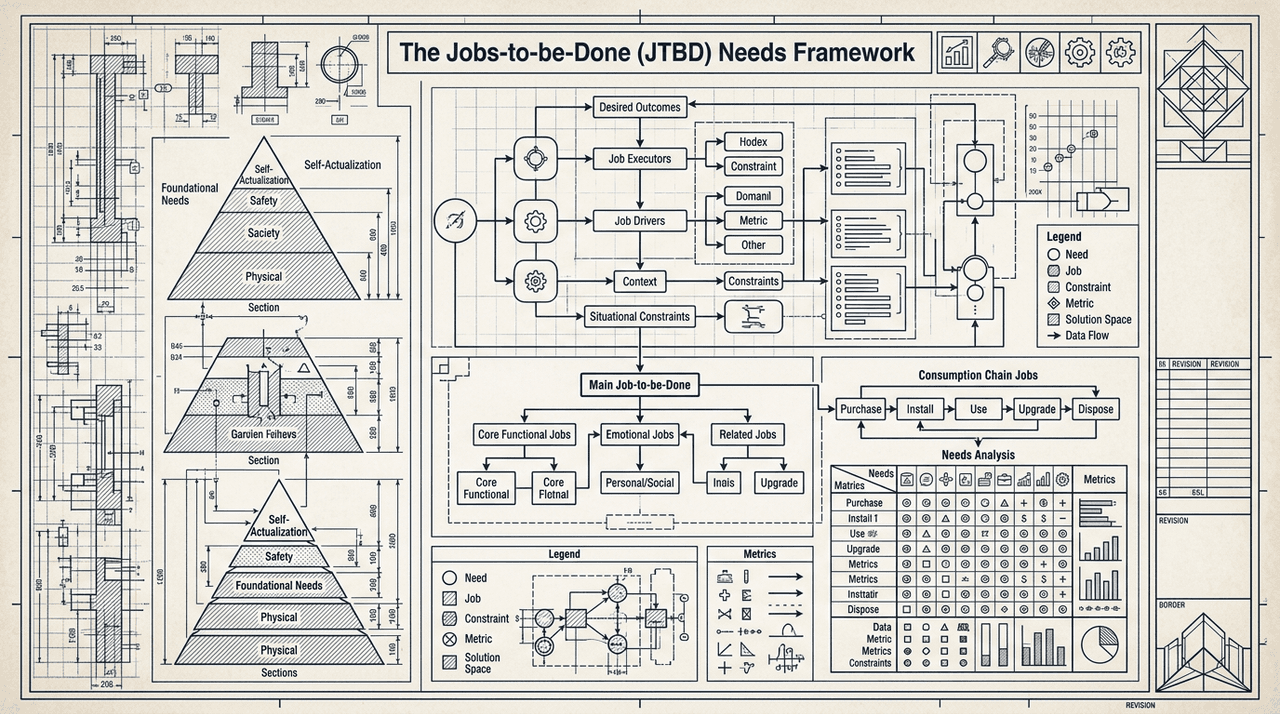
1. Beyond the Hole: Reimagining Customer Needs
Innovation becomes a predictable science only when we capture Desired Outcomes. Traditional “ideas-first” innovation has an 83% failure rate. By adopting a “needs-first” architecture, the success rate jumps to 86%.
2. The Anchor: The Core Functional Job
The Core Functional Job is the stable anchor of your strategy.
| Characteristic | Definition | Example (Music) |
|---|---|---|
| Stable | Does not change over time. | ”Listen to music” |
| Solution-Agnostic | Independent of technology. | Exists for CDs and Streaming. |
| Universal | Same across cultures. | Same in Tokyo and New York. |
3. The Human Element: Related and Emotional Jobs
- Related Jobs: Additional tasks the user tries to accomplish before, during, or after the core job.
- Emotional and Social Jobs: How the user wants to feel or be perceived.
4. The Support System: Consumption Chain and Purchase Decision Jobs
- Consumption Chain: The physical lifecycle of the product (Purchase, Install, Setup, Maintain, Repair, Dispose, etc.).
- Purchase Decision: Executed by the Buyer using financial metrics (Financial Desired Outcomes).
5. Synthesis: The Framework in Action
Example: Surgical Medical Instrument
- Core Job: Restore blood flow.
- Executor: Surgeon.
- Related Job: Monitor vitals.
- Emotional Job: Feel confident.
- Consumption Chain: Simplify sterilization for nurses.
- Purchase Decision: Reduce patient length of stay.
6. The DNA of a Need: Desired Outcome Statements
Formula: [Direction] + [Metric] + [Object of Control] + [Context]
- Example: “Minimize the likelihood that the music sounds distorted when played at high volume.”
Summary: From Theory to Predictable Innovation
- Define the Metric, Not the Solution: Capture 50–150 Desired Outcomes.
- Focus on Stability: Jobs stay, products fade.
- Choose Your Growth Strategy: Differentiated, Dominant, Disruptive, Discrete, or Sustaining.